Confessions of a Climate Kook
By Dr. Jason Creaghan
I am standing on Wellington Street in front of the Parliament buildings while a group of teenagers gather for a Fridays for Future Climate Change protest. A smaller group of adult “supporters” mills about waiting. It’s awkward as small protest gatherings are, as dissent is.
The kids, however, don’t seem intimidated at all by the indifference of the office workers passing them by. They have been doing this every Friday for months. Some sign is given and the group begins to move and chant. Their energy pulls the adult stragglers along. They chant while we chat.
“Where are all the dudes?” one Mum grumbles. The kids are mostly girls. “I just thought they deserved to have someone else show up,” one of the parents tells me. “I’m just here to take pictures,” a Dad clarifies.
As the traffic and bustle of the noontime crowd swirls around me, I realize that I have crossed a line, and to those on the other side, I have become a kook.
Since Greta Thunberg began mobilizing millions of young people and Extinction Rebellion made headlines by shutting down central London in October 2018, I have felt increasingly drawn in to a disturbing narrative that has been percolating through our culture.
It goes something like this: unless we come together to transform our economy and culture in the next ten years, climate change will cause massive human suffering and displacement, and the 6th major extinction of life on our planet.
So I lost interest in air travel to exotic places. I became a vegetarian. I started to bike to work. I began to attend small gatherings of people who also felt compelled to come together to demonstrate, block off the Laurier Bridge, or pour red (biodegradable) paint on the entrance yard to the Canadian Museum of History.
I dislike conflict and I don’t like telling people what to do. Noisy demonstrations are way out of my comfort zone. So I wonder why I am so affected by this issue that I would consider civil disobedience as an option. Maybe I am disturbed, as a number of politicians had implied of climate activists in the recent past.
All zealots are convinced of the righteousness of their cause. I wonder how my cause is different than any other. I worry that I will alienate my friends and family. I realize I make a terrible zealot – too many doubts!
I volunteer to sleep over at the climate emergency camp that Extinction Rebellion has set up on a frozen patch of park in downtown Ottawa. Since late November, one woman has lived here, supported by a growing number of activists and supporters.
After a mostly sleepless night of sirens and freezing rain I get up at 6:00 am to go and find a coffee. At the entrance to the Tim Hortons I slip on a patch of ice and sprawl in a puddle of freezing slush. The woman the counter looks me over quickly and decides I am probably harmless. Dripping and bleary I give my order. “I am a climate activist not a homeless person,” I want to say. Instead I get my coffee and slink back to my tent to wait for the real climate activists to take over.
When so many of us clearly understand the climate catastrophe that is looming, I want to know why saying it out loud makes me feel like an outsider.
“I don’t want to feel like a kook any more,” I tell an old and trusted friend.
“Then stop doing weird things.” She looks at me with patient concern. “Just stop!”
I tell her that I’ll stop.
Back at Rideau and Sussex, the Fridays for Future protest passes through the busiest intersection in Ottawa and heads back up Wellington Street to the climate camp. The crowd mingles and the kids get a hug from the residents. This place has become the focus of a small community and many of us know each other by name.
We chat for a while and stamp our feet to keep warm. I am drawn to these people who are willing to disrupt their lives and face the indifference and possibly the hostility of the rest of us. I admire their courage.
Most of us who are suffering from climate grief, the despair that we feel as the implications of global warming become more obvious, seem stuck in various forms of denial. I sympathize with my friends who have come to the conclusion that nothing that we do will matter.
I understand the instinct to turn away from something so overwhelming and focus on maintaining order and happiness in our immediate lives. I suspect however that they are haunted, as I am, by the same question: what would I be willing to do if it did matter?
In the end I did not take my friend’s advice. But now I try to mix some normal in with the crazy. “Hon, could you drive Will to hockey? I’m sleeping downtown in a tent tonight. I’ll get some groceries on the way home.”
If I lose a little bit of credibility along the way, I also learn to take myself less seriously.
Once a week now I deliver lunch to the folks at the climate camp. I drop off my packages and sit for a while in the tent that serves as a meeting space to get some news. I still think about the day when I am confronted by my grandchildren who will ask me what I knew, and when.
Perhaps it will be a small consolation to be able to say, that in some naïve and ineffectual way, I tried to do something. But for now this weekly chore is simply an antidote to climate grief. It’s about not apologizing for trying to save the world, and trying to live in it with a little more courage. Dr. Jason Creaghan and his wife, Deanna Young, live in Chelsea, Quebec.
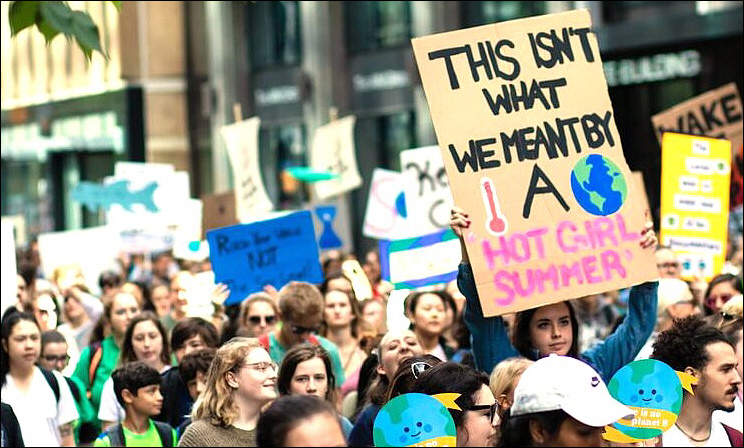
The young and the restless by the thousands march on Parliament Hill for climate action in September 2019 (Photo: Dr. Jason Creaghan)
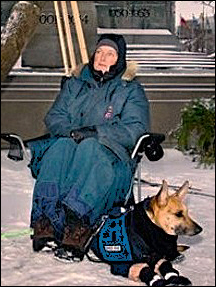
The activist who wouldn’t come in from the cold at the Ottawa climate emergency camp in February 2020 (Photo: Dr. Jason Creaghan)